Circular economy is often shortened to recycling, especially in business conversations where circularity is reduced to waste diversion targets and recycling rates. That assumption, though, overlooks the broader impact of what circular economy practices can be.
According to research published in Resources, Conservation and Recycling, the United States generates 200–300 million tons of non-hazardous industrial waste each year, showing how much material value is already lost by the time recycling begins.
In a business context, a circular economy focuses on keeping assets, equipment, and materials in productive use for as long as possible while reducing value loss across their lifecycle.
The objective is not just to manage waste, but to limit unnecessary new purchases, control costs, and reduce supply chain risk through circular procurement.
Recycling supports this goal, but it usually enters the process after functional and financial value is already gone. A strong circular approach looks upstream first and treats recycling as one option, not the foundation.
In this exploration, we’ll dive into why recycling is incomplete on its own and which circular economy practices deliver more impact for business.
The focus is on practical methods that help you keep assets in use longer, reduce unnecessary purchases, and build a circular economy strategy that works beyond recycling.
What Is a Circular Economy
A circular economy is a way of managing production and consumption that focuses on keeping products, materials, and assets in active use for as long as they retain value.
It replaces the “use it, scrap it, replace it” cycle with a model centered on value retention. The priority is to preserve function first, then recover the remaining value once that function can no longer be maintained.
In industrial and enterprise environments, a circular economy is defined by how machinery, equipment, and materials are managed across their lifecycle, with decisions guided by long-term value rather than short-term disposal.

Why Recycling Is Not Enough
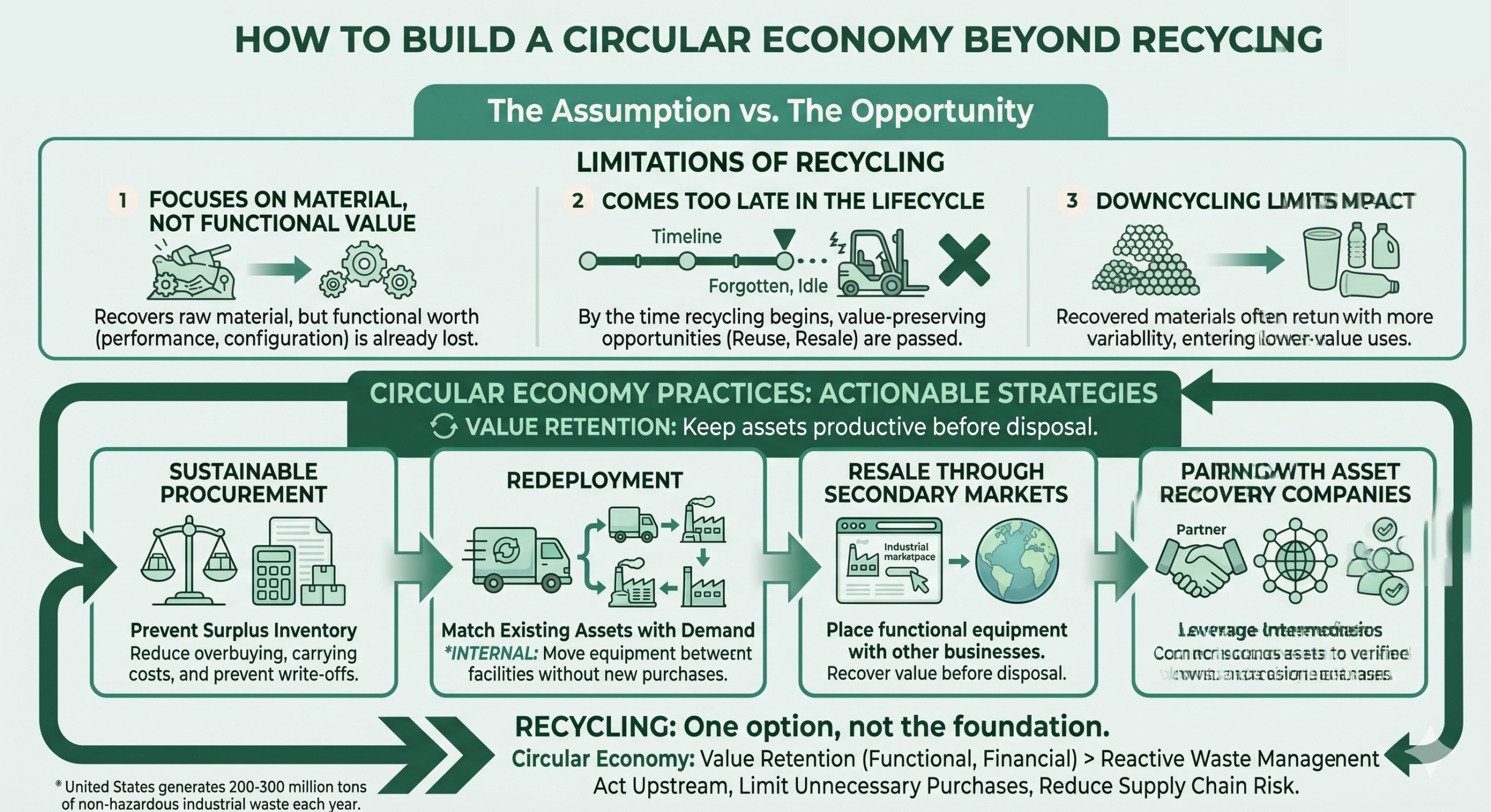
Recycling plays a role in a circular economy, but it cannot carry the strategy on its own. It addresses waste after assets and materials have already lost most of their business value. That makes recycling a reactive measure, not a value-preserving one.
1. Recycling Focuses on Material, Not Functional Value
Recycling recovers raw materials after products and equipment can no longer perform their intended function. At this stage, functional value is already gone.
Performance, configuration, and serviceability no longer matter. What remains is scrap value, which is often only a small fraction of the asset’s original worth.
This is the core limitation of recycling in a circular economy. It manages materials after failure instead of keeping assets productive while they still have usable life.
2. Recycling Comes Too Late in the Lifecycle
By the time recycling becomes an option, opportunities to preserve value have already passed. Equipment may have experienced prolonged idle time.
Components may no longer meet operational requirements. Chances for reuse, redeployment, or resale are lost. Recycling does not prevent early retirement or underutilization of assets.
3. Downcycling Limits Economic Impact
Even when recycling is successful, recovered materials often return with more variability in grade, form, or specification. This can limit their use in high-precision or high-performance applications.
As a result, recovered materials often enter lower-value uses rather than replacing original inputs.
Circular Economy Practices Beyond Recycling
A circular economy works when businesses act before assets reach the end of their life. Value retention happens by keeping equipment productive instead of waiting for disposal.
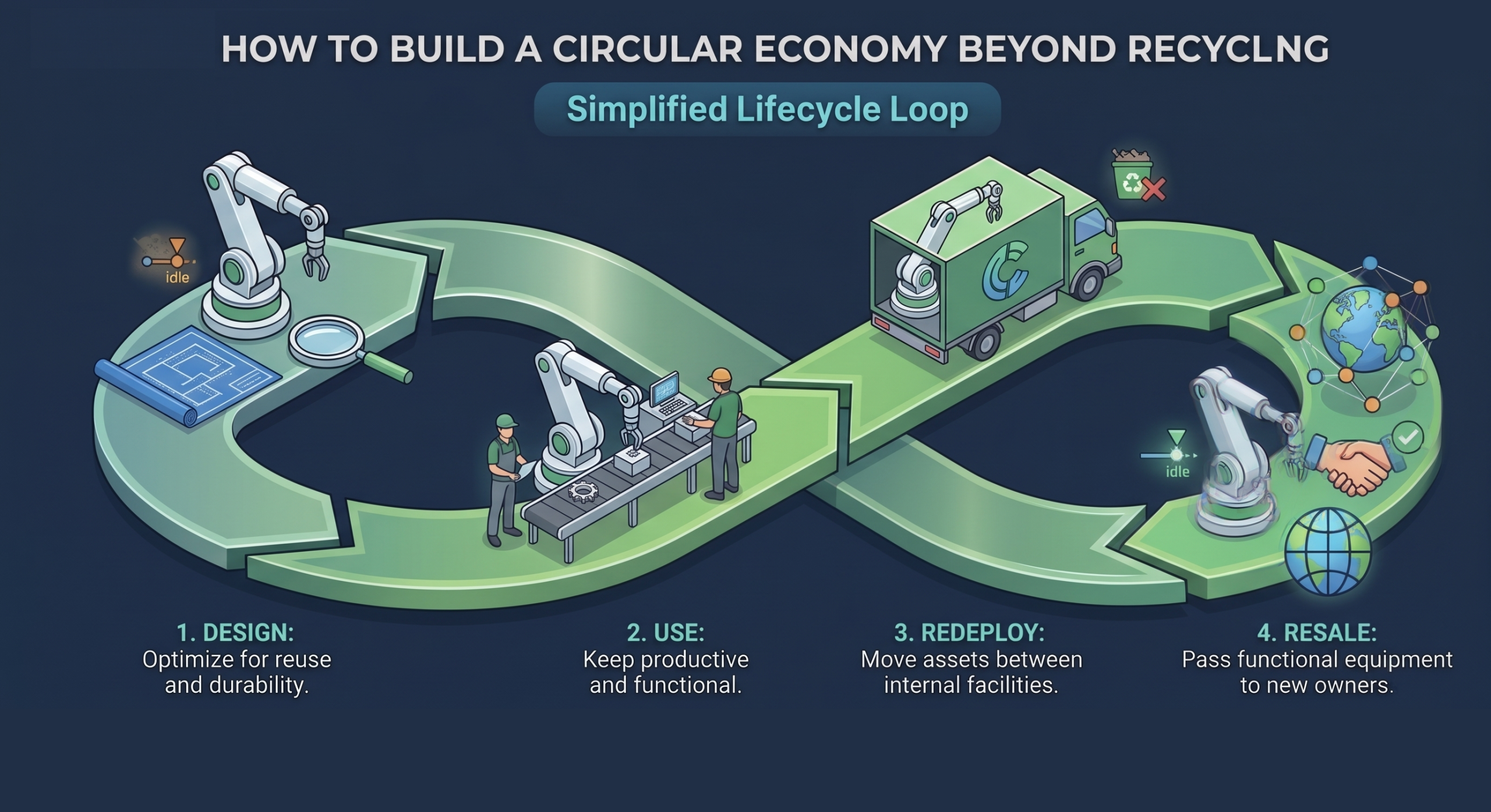
Below are the key circular economy practices that help preserve functional value before recycling becomes necessary.
1. Sustainable Procurement to Prevent Surplus Inventory
A circular economy starts before you buy. If you avoid over-purchasing, you prevent surplus inventory from building in the first place. That reduces idle stock, storage costs, and write-offs in the future.
Sustainable procurement means buying what you will use, based on real demand. It also means purchasing in a way that keeps options open, so you can redeploy, return, or resell without losing value.
This matters most for MRO inventory, spare parts, and indirect categories where “just in case” purchasing becomes the default.
Key outcomes of sustainable procurement include:
- Reducing overbuying that creates idle inventory
- Lowering carrying costs tied to storage, insurance, and obsolescence
- Improving inventory turns and freeing working capital
- Preventing write-offs before they happen
Most companies struggle here because procurement teams optimize for uptime. Buyers get measured on speed and availability, not on preventing future surplus.
When demand shifts or equipment changes, “just in case” stock becomes idle inventory, and the business deals with it later through storage, write-offs, or disposal.
2. Redeployment
Redeployment keeps functional equipment in use by matching existing assets with new demand. It protects value earlier in the lifecycle and reduces the need for new production.
Internal Redeployment
Internal redeployment moves equipment between facilities or business units within the same organization. It allows businesses to meet operational needs without triggering new purchases.
Key outcomes include:
- Moving equipment to locations where it is still needed
- Avoiding unnecessary capital spend on replacement assets
- Preserving functional value with minimal operational friction
Because ownership stays internal, assets remain easier to track, validate, and deploy. Equipment continues working without entering the surplus or disposal stream.
Internal redeployment sounds simple, but most supply chains struggle with it. Many facilities manage inventory in isolation, with no visibility across sites.
In acquisition-heavy organizations, the problem runs deeper because different locations often operate on separate ERP systems.
Without shared visibility, companies cannot take the first step towards transferring usable equipment and spare parts across sites.
3. Resale Through Secondary Markets
Resale keeps functional equipment in use by placing it with businesses that still need it.
Instead of treating surplus as waste, secondary markets allow assets to continue operating in new environments.
This extends asset life beyond a single organization and supports circular economy outcomes before recycling becomes necessary.
Key outcomes of resale include:
- Recovering value before disposal
- Reducing write-offs tied to idle or surplus assets
- Keeping equipment productive instead of moving directly to scrap
- Diverting industrial waste from landfills and reducing emissions from new production
In industrial environments, resale often happens through business-to-business liquidation. This is where idle machinery, excess MRO inventory, and redundant equipment move directly from one business to another instead of heading to scrap or disposal.
When managed correctly, this channel supports reuse and refurbishment across industries.
Resale enables cross-industry, cross-country, and even cross-globe reuse. Equipment retired from one operation often can fit another use case with minimal adjustment.
Manufacturing lines, material handling equipment, and industrial systems can retain significant usable life even after internal demand ends.
4. Pairing with Asset Recovery Companies
Pairing with asset recovery companies supports the circular economy because these firms act as intermediaries for value circulation.
They operate between sellers and buyers and use established business networks to identify where surplus assets can be reused, refurbished, or redeployed.
When you work with an asset recovery company, surplus assets are not simply listed and left idle. They are assessed, positioned, and matched to verified buyer demand.
Access to active buyer and seller networks helps move idle machinery, excess MRO inventory, and redundant industrial assets back into productive use.
This keeps functional assets in circulation and delays disposal and recycling until no other option remains.
Key outcomes of pairing with asset recovery companies include:
- Connecting surplus assets to verified buyers through established networks
- Increasing reuse and redeployment rates through faster matching
- Reducing storage time and lowering holding costs
- Recovering value while supporting circular economy objectives
Most machines and parts still have value even when they reach the end of their use inside your organization. The challenge is finding the next user.
Industrial production lines are diverse, specialized, and highly specific, which makes buyer matching difficult without the right network.
Asset recovery companies solve that gap by specializing in specific industries and equipment categories. They build relationships with both sellers and buyers, often around one or two core use cases.
That expertise allows them to move surplus assets into the right hands faster, with less friction and less value loss.
Conclusion
Recycling supports circularity, but it does not define it. It is an end-of-life tool that recovers material after most functional value is gone.
If your circular economy practices starts with recycling, much of the value has already been lost.
Circular economies depend on keeping assets in use longer. That means treating machinery, equipment, and materials as value holders across their lifecycle, not as disposal problems.
Redeployment, resale, liquidation, and repair-focused lifecycle management keep the function in the system and protect value earlier.
Businesses gain more by acting before disposal. You reduce unnecessary replacement, reduce carrying costs, protect capital, and keep operations flexible when demand shifts.
Then, when recycling becomes the right move, it plays its role as the final step, not the default plan.
Frequently Asked Questions
How is a circular economy different from recycling?
A circular economy keeps products, equipment, and materials in use for as long as they still hold value. Recycling comes later, after reuse, redeployment, repair, or resale is no longer practical.
When is recycling the right option in a circular economy?
Recycling is the right option when an asset can no longer be reused, repaired, redeployed, refurbished, or resold. At that stage, recycling helps recover remaining material value and reduce waste.
How can a business identify circular economy opportunities?
A business can start by reviewing idle equipment, excess inventory, spare parts, and underused assets across all locations. This helps teams see what can be reused internally, resold, repaired, or sent to recovery channels.
How can companies measure circular economy success?
Companies can measure success through avoided purchases, resale revenue, redeployment rates, reduced storage costs, lower write-offs, and waste diverted from disposal. These metrics show both financial and operational impact.
When should a company work with an asset recovery partner?
A company should work with an asset recovery partner when it has surplus machinery, excess MRO inventory, or idle equipment that cannot be redeployed internally. The right partner can help assess value, find qualified buyers, and recover value before disposal.