For most global enterprises, net zero through reductions alone isn’t possible. Even if you do everything possible to decarbonize your operations, there will always be some that you simply can’t avoid.
That’s where carbon credits come in.
Carbon credits are a powerful tool that help companies hit their compliance targets and support their long-term strategic goals. But as scrutiny around credits increases, so does the need to ensure the ones you source meet the highest quality criteria.
In this piece, we’ll dig into carbon credits and carbon projects. You’ll learn what carbon credits are, what makes them “high quality,” and how to source ones that can stand up to any greenwashing claim.
Keep reading to learn:
- What are carbon credits
- Why carbon credit quality matters
- Who determines the quality of a credit
- 3 key things to keep in mind during procurement
What are carbon credits?
Carbon credits are internationally recognized tradeable environmental assets. They were formally introduced via the Kyoto Protocol in 1997 and became used around the world in the early 2000s. Each individual credit represents one metric tonne of greenhouse gas (GHG) emissions that has been reduced, avoided, or removed from the atmosphere.
The scale of this market has grown significantly over the past two decades. What began as a niche mechanism tied to international climate agreements has matured into a multi-billion-dollar global market spanning thousands of registered projects. As demand has surged, so has complexity, leaving many procurement teams unsure how to separate credible credits from those that exist mostly on paper. Understanding the fundamentals is the first step toward building a defensible strategy.
Typically, assets fall into two primary markets:
- Compliance markets: Credits purchased to uphold specific government mandates or regulatory standards.
- The voluntary carbon market (VCM): Credits purchased as part of a discretionary climate action plan, often issued by standards like the Gold Standard or VERRA.
Here is a video from The Invading Sea explaining carbon offsetting in more detail:
What makes a high-quality carbon credit?
Carbon credits are generated by carbon projects. When we talk about the “quality” of a credit, we’re really talking about the quality of the project.
High quality carbon credits come from projects that support real, meaningful, measurable climate action. These are credits from projects that, ultimately, do one of these two things:
- Remove carbon: Some projects, like afforestation, reforestation, biochar, and land use projects can help remove and sequester carbon.
- Reduce or avoid emissions: Projects that involve waste management, energy efficiency, and renewable energy and help reduce or avoid creating emissions.
Top-quality credits come from climate projects that follow approved methodologies. They also often support the advancement of the UN sustainable development goals by:
- Growing local economies: Projects often require significant manual labor and specialized roles, from planting trees in reforestation efforts to technicians maintaining methane capture facilities.
- Incentivizing infrastructure development: Projects frequently invest in local infrastructure, such as building reliable roads for transport, establishing renewable energy microgrids, or improving water management systems.
- Providing food security: Economic growth from project wages allows families to afford more consistent, nutritious food.
- Enhancing access to healthcare: A portion of the revenue generated from selling carbon credits is often reinvested into the community to build local clinics or fund mobile health units.
These co-benefits are increasingly viewed as central to credit quality rather than optional extras. Buyers and regulators alike now expect projects to demonstrate tangible improvements in the communities where they operate. A project that delivers verified emissions reductions while also strengthening local livelihoods is far more resilient to scrutiny than one focused on carbon alone.
Take a forestry project, for example. Planting trees can help sequester carbon, which is one goal. However, the project itself can also have the added effect of bringing additional income streams to local landowners and creating new jobs, both of which can stimulate community growth and development.
How can I tell if a credit meets quality standards?
Voluntary carbon markets exist outside of regulations. There are no governmental authorities that evaluate these credits for quality or transparency.
That’s where non-governmental organizations step in. For carbon credits, the most influential organization is the Integrity Council for the Voluntary Carbon Market (ICVCM). The ICVCM is an independent non-profit governance body that establishes and maintains worldwide integrity standards in the voluntary carbon market.
The organization has defined ten fundamental, science-based principles for identifying high-quality carbon credits, which it calls the Core Carbon Principles (CCP).
These principles create the foundation of the Assessment Framework (AF), which the ICVCM uses to determine if a carbon crediting program meets its standards and can earn a CCP label.
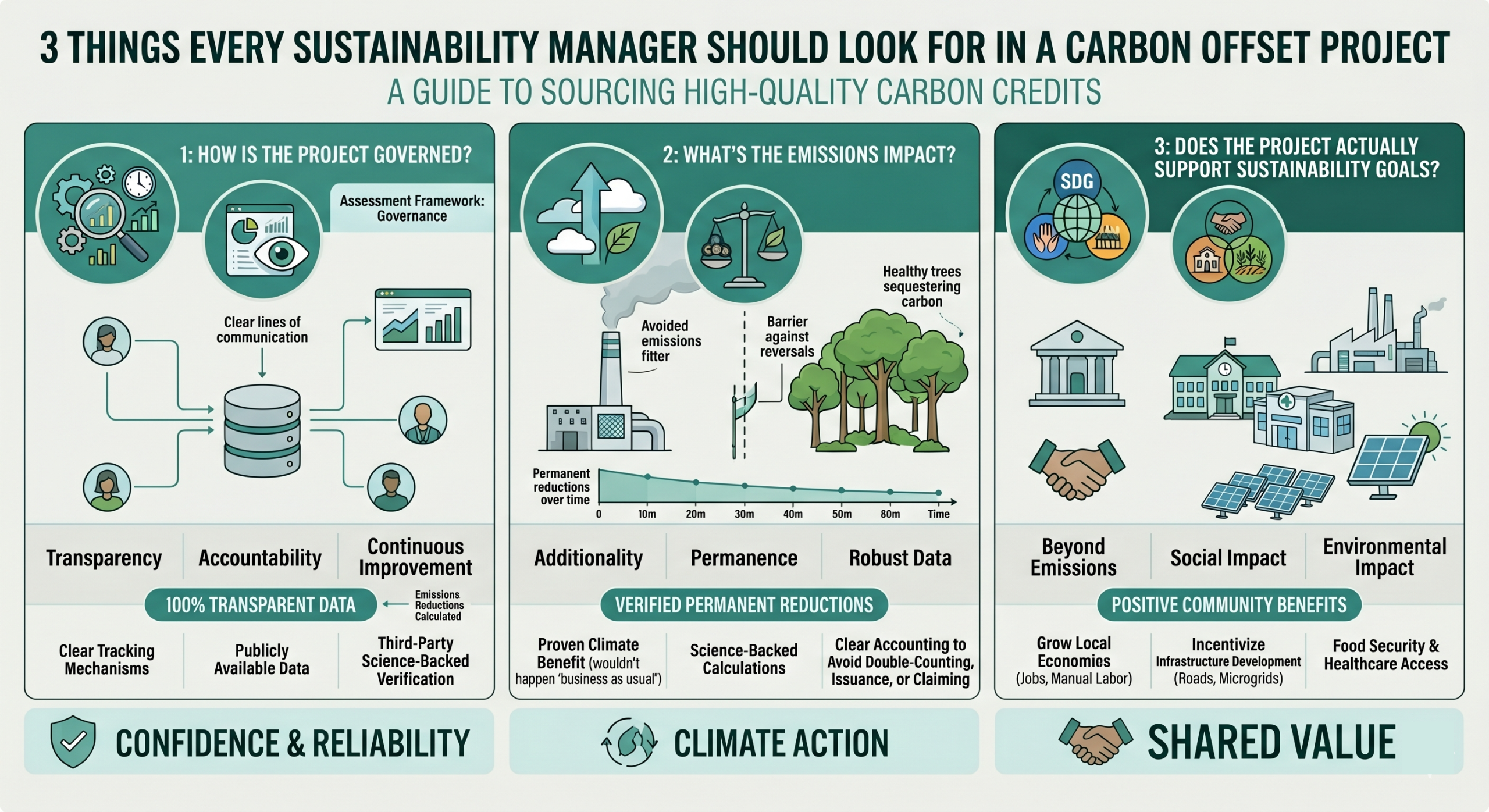
This framework is a helpful tool when it comes to evaluating credits or carbon offset projects. It’s broken into three core components:
1. How is the project governed?
Carbon projects are only as effective as their governance. That means the teams responsible for the program need to have systems in place that ensure transparency, accountability, and continuous improvement.
As you evaluate projects and credits, look at the data. Does the program have clear tracking mechanisms? Is all the data publicly available? You should be able to evaluate how emissions reductions are calculated and see the environmental and social impacts of a project.
Additionally, look for independent third-party verification from science-backed sources. The role of these verifying bodies is to confirm that the claimed emissions reductions are accurate and meet the program’s rules.
2. What’s the emissions impact?
It sounds obvious, but carbon credits should actively reduce carbon emissions. For the ICVCM, that means two important things:
- Additionality: The emissions reduction should be a direct result of the program efforts (thereby proving the program’s efficacy).
- Permanence: The reductions or removals should be permanent (or have systems in place to compensate for reversals).
Every program should have robust data sets that demonstrate its impact. These emissions calculations should be done according to conservative estimates and using science-backed principles.
Programs should also have clear accounting principles. This is to avoid:
- Double-counting (multiple parties claiming the same credit)
- Double issuance (multiple credits generated for the same reduction)
- Double claiming (claims overlapping with mandatory domestic mitigation schemes)
3. Does the project actually support net-zero goals and sustainability goals?
Mitigation efforts need to go beyond just removing or reducing emissions. They also must create a broader social and environmental impact.
If, for example, a project reduces carbon emissions but does it at the expense of human rights, it’s unlikely the ICVCM would award the CCP label.
The same is true for environmental goals; if the project requires carbon-intensive processes to hit the reduction target, it’s considered antithetical to the end goal of the system.
Every carbon credit should come from a project that goes beyond best practices on social and environmental safeguards. The end goal is always an emissions reduction, but the means of getting there must be justified, too.
How to avoid greenwashing during procurement
Carbon credits have come under scrutiny in recent years. The voluntary carbon market’s lack of oversight has historically led to several systemic issues:
- Double counting: Where a single emission reduction is claimed by two different entities.
- Inconsistent methodologies: Accounting errors that result in investments that sound good on paper but fail to create real-world impact.
- Lack of proof: Without clear accounting, companies haven’t been able to prove the impact they’ve created.
Regulators all over the world have noticed. So have consumers and investors. Both are holding companies to higher expectations every year and pushing for more intentional, high-quality carbon credit strategies.
If you’re starting to build a procurement process, consider exploring the following areas for investment:
- Look for credits that decarbonize your value chain: Look for ways you can support projects that could help decarbonize your value chain. This will help incentivize upstream and downstream investment and support your Scope 3 reductions in the future.
- Look for credits in the countries in which you operate: It’s best practice to purchase credits that support the local economies and environments near your operations.
- Look for credits that support your business vision and mission: Your carbon credit strategy should feel like a natural extension of your business strategy. Find credits that support your vision of the future.
Beyond these three areas, it pays to document your decision-making throughout the procurement process. Keeping clear records of why you selected specific projects, which standards they meet, and how you verified their claims gives you a strong position if questions arise later. This kind of transparency is quickly becoming an expectation rather than a differentiator.
Low-quality carbon credits create more risk than they are worth
Carbon credits are nothing new, and many companies have been purchasing them for years to meet compliance mandates.
What is changing, though, is the emphasis on quality. Now, more than ever, regulators and investors want to see that investments in carbon credits lead to meaningful change.
Getting started is the hardest part of the process, and it can pay to work with a sustainability partner to guide you through the strategy.
Frequently Asked Questions
What are trusted registries for sourcing high-quality credits?
If you’re ready to source credits, look to trusted, third-party registries like:
Verified Carbon Standard
Puro.earth
Gold Standard for the Global Goals
Climate, Community, & Biodiversity Standards
American Carbon Registry
Each of these registries is recognized by the International Carbon Reduction and Offset Alliance (ICROA) for meeting strict environmental and methodological benchmarks.
You can also use assessments from BeZero Carbon and Calyx Global to evaluate project quality.
How do I determine if a credit is truly "additional"?
Additionality means the emissions reduction or removal is a direct result of the project’s specific intervention. To be high-quality, the project must prove that the climate benefit would not have occurred under a "business as usual" scenario without the funding from the carbon credit.
How do I build a carbon credit procurement process?
The best advice is to work with an expert who can help you build a plan according to your strategy. Look for reputable companies with track records in your industry. You’ll also want to find a company with local expertise in your market
What’s the difference between a carbon credit and a carbon project?
A carbon project is the actual physical activity on the ground—such as a reforestation initiative or a methane capture facility—that reduces or removes emissions. A carbon credit is the tradeable financial asset generated by that project, representing one metric tonne of CO2 verified to have been mitigated.
Resources
- ICVCM.org: The Core Carbon Principles
- Calyx Global: What makes a high-quality carbon credit
- The Greenhouse Gas Protocol: Standards and Guidance