


Copper is a versatile and valuable metal used extensively in industries ranging from construction to electronics to decorative arts. This nonferrous metal is considered 100% recyclable, meaning it can be recycled repeatedly without losing performance or quality. This makes it an excellent candidate for sustainable resource management.
Copper recycling companies are using new and innovative ways to conserve this precious material and significantly reduce environmental impact and waste.
Many metal recycling companies have developed sophisticated methods for collecting, processing, and repurposing scrap copper. These enterprises play a crucial role in the circular economy of metals.
This article examines the 12 leading copper recycling companies, providing insight into their operational processes and range of services. By exploring these industry leaders, we can learn more about copper recycling and its importance in a sustainable circular economy.
Understanding the World of Copper Recycling
Copper, a vital and versatile metal, is indispensable across numerous industries, from electronics and telecommunications to construction, automotive manufacturing, and renewable energy systems. Its exceptional electrical conductivity, thermal conductivity, and malleability make it highly sought after for a myriad of applications.
However, the traditional method of mining new copper is an incredibly resource-intensive process, leading to significant environmental impacts such as habitat destruction, extensive land use, and substantial energy consumption. This is precisely where copper recycling plays a pivotal and increasingly critical role.
Copper recycling involves the systematic collection, processing, and transformation of scrap copper into new, usable forms, drastically reducing the need for virgin ore extraction. It stands as a cornerstone of the circular economy, effectively transforming what would otherwise be considered waste into valuable secondary raw materials, thereby mitigating ecological footprints and conserving finite natural resources.
Understanding the intricacies of this process, and identifying the leading companies driving these essential efforts, is crucial for businesses, policymakers, and individuals committed to fostering truly sustainable industrial practices.
This comprehensive guide aims to explore the dynamic landscape of top copper recycling companies, detailing their innovative operations, their profound environmental and economic impact, and the key factors that distinguish them as leaders in a competitive and rapidly evolving market.
Why Copper Recycling is Essential for a Sustainable Future
The benefits of recycling copper extend far beyond simple waste management; they are fundamental to achieving global sustainability goals and fostering a more resilient economy. Firstly, recycling copper significantly conserves natural resources.
Copper is a finite resource, and extracting it from the earth requires extensive mining operations that can lead to severe environmental degradation, including habitat destruction, soil erosion, water pollution, and disruption of local ecosystems.
By contrast, utilizing recycled copper drastically reduces the demand for new mining activities, preserving natural landscapes and biodiversity. Secondly, the energy savings associated with copper recycling are truly substantial. Producing copper from recycled materials uses an astonishing 85-90% less energy than producing it from virgin ore.
This dramatic reduction in energy consumption directly translates to lower greenhouse gas emissions, playing a critical role in combating climate change and reducing the overall carbon footprint of industrial processes.
Furthermore, copper recycling minimizes landfill waste, preventing valuable materials from being discarded and contributing to overflowing waste sites.
It also creates robust economic opportunities, supporting numerous jobs in collection, sorting, processing, and manufacturing sectors globally. Embracing copper recycling is not merely an environmental imperative; it represents a profound economic and social responsibility that underpins a more resilient, resource-efficient, and sustainable future for industries and communities worldwide.
Key Criteria for Identifying Top Copper Recycling Companies
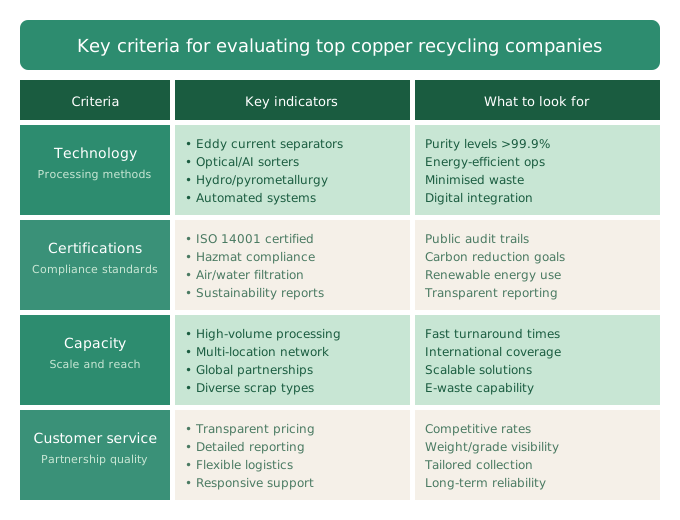
When embarking on the search for the “top copper recycling companies,” it is absolutely crucial to establish clear and comprehensive benchmarks for evaluation.
The copper recycling industry is incredibly diverse, with players ranging from small, local scrap yards to vast, multinational corporations operating on a global scale. A truly leading company distinguishes itself through a powerful combination of operational excellence, unwavering environmental stewardship, and highly customer-centric approaches.
Key criteria for assessment include their adoption of advanced recycling technologies, which ensures maximum recovery rates, high material purity, and minimized waste. Their demonstrable commitment to stringent environmental compliance and the attainment of recognized certifications, such as ISO 14001 for environmental management systems, serves as a clear indicator of responsible and sustainable practices.
The company’s processing capacity and global reach are also immensely important, signaling their ability to efficiently handle large volumes of scrap and serve diverse markets across different geographies. Finally, exceptional customer service, characterized by transparent reporting, fair and competitive pricing, and reliable logistics, are all hallmarks of a reputable, trustworthy, and reliable recycling partner.
By meticulously assessing these multifaceted factors, businesses and other stakeholders can make highly informed decisions, ensuring they collaborate with companies that not only meet their specific copper recycling needs but also contribute positively and significantly to the planet’s health and the advancement of the circular economy.
Advanced Recycling Technologies
Top copper recycling companies distinguish themselves through substantial investment in cutting-edge technologies designed to maximize efficiency, purity, and minimize environmental impact. This technological prowess begins with sophisticated sorting systems, which are critical for separating copper from other metals and non-metallic contaminants.
These often include advanced eddy current separators, optical sorters utilizing spectral analysis, and even robotic systems powered by artificial intelligence that can identify and segregate different grades of copper with remarkable precision. Following initial sorting, advanced shredding and granulation equipment break down complex scrap, such as insulated wires or electronic components, into smaller, more uniform pieces.
This preparation is essential for subsequent refining processes. For achieving high purity levels, often exceeding 99.9%, companies employ refined hydrometallurgical or pyrometallurgical techniques. Hydrometallurgy involves chemical leaching to dissolve copper, followed by electrowinning to recover pure metal, while pyrometallurgy uses high-temperature furnaces.
These processes are continuously optimized to reduce energy consumption, minimize water usage, and control emissions. For instance, some facilities utilize inert atmosphere furnaces to prevent oxidation during melting, thereby improving recovery rates and reducing material loss.
The integration of digital technologies and automation further enhances operational safety, precision, and overall resource recovery, ensuring that valuable copper resources are recovered as efficiently and sustainably as possible, thereby contributing significantly to a truly circular economy.
Environmental Compliance and Certifications
A defining characteristic of leading copper recycling companies is their unwavering and demonstrable commitment to environmental responsibility, which goes far beyond mere regulatory adherence. This commitment is often concretely demonstrated through strict adherence to stringent environmental regulations at local, national, and international levels, coupled with the attainment of recognized industry certifications.
Companies that genuinely prioritize sustainability typically hold certifications such as ISO 14001 for environmental management systems. This certification signifies a structured, systematic approach to identifying, managing, monitoring, and minimizing their environmental impact across all operations. Furthermore, top recyclers meticulously comply with all waste management and hazardous material handling laws, ensuring safe and responsible processing of all materials.
Beyond basic compliance, many leading firms implement proactive and innovative measures. This includes investing in advanced air filtration systems to significantly reduce atmospheric emissions, implementing sophisticated wastewater treatment plants to manage and purify process water responsibly, and actively working to minimize their overall carbon footprint through energy-efficient operations and renewable energy sourcing.
Transparent reporting on their environmental performance, coupled with continuous improvement initiatives and public sustainability reports, further solidifies their position as responsible and forward-thinking industry leaders. Choosing a certified company provides assurance that your copper scrap is processed in an eco-friendly, legally compliant, and ethically sound manner, contributing to a cleaner planet.
Environmental Compliance and Certifications
A defining characteristic of leading copper recycling companies is their unwavering and demonstrable commitment to environmental responsibility, which goes far beyond mere regulatory adherence. This commitment is often concretely demonstrated through strict adherence to stringent environmental regulations at local, national, and international levels, coupled with the attainment of recognized industry certifications.
Companies that genuinely prioritize sustainability typically hold certifications such as ISO 14001 for environmental management systems. This certification signifies a structured, systematic approach to identifying, managing, monitoring, and minimizing their environmental impact across all operations.
Furthermore, top recyclers meticulously comply with all waste management and hazardous material handling laws, ensuring safe and responsible processing of all materials. Beyond basic compliance, many leading firms implement proactive and innovative measures.
This includes investing in advanced air filtration systems to significantly reduce atmospheric emissions, implementing sophisticated wastewater treatment plants to manage and purify process water responsibly, and actively working to minimize their overall carbon footprint through energy-efficient operations and renewable energy sourcing.
Transparent reporting on their environmental performance, coupled with continuous improvement initiatives and public sustainability reports, further solidifies their position as responsible and forward-thinking industry leaders. Choosing a certified company provides assurance that your copper scrap is processed in an eco-friendly, legally compliant, and ethically sound manner, contributing to a cleaner planet.
Capacity and Global Reach
The scale of operations and geographical footprint are significant and often defining indicators of a top copper recycling company’s capabilities and influence within the industry. Leading firms typically possess extensive processing capacities, meaning they are capable of efficiently handling vast quantities of diverse copper scrap. This can range from large industrial offcuts and demolition scrap to intricate end-of-life products like electronic components.
This robust capacity ensures efficient turnaround times, allowing them to meet the demanding schedules and high-volume requirements of large-scale industrial clients and commercial enterprises. Furthermore, many top companies operate across multiple strategic locations, or have cultivated a vast global network of partners and collection points.
This expansive global reach allows them to serve international markets effectively, facilitating the collection and processing of copper scrap from various sources across different continents. Such a widespread presence contributes significantly to a more efficient and resilient global supply chain for recycled metals.
Whether a client requires localized collection services for smaller batches or comprehensive solutions for international shipments and large-scale industrial waste streams, a company with substantial capacity and broad geographical reach can offer comprehensive, reliable, and scalable recycling solutions tailored to diverse needs.
This capability is crucial for businesses looking for consistent and dependable recycling services regardless of their operational scale or location.
Customer Service and Transparency
Beyond impressive technological prowess and robust environmental credentials, the very best copper recycling companies distinguish themselves through an unwavering commitment to exceptional customer service and absolute transparency in all their dealings.
This commitment begins with clear, concise communication regarding all aspects of their service, including pricing structures, estimated processing timelines, and specific material acceptance policies. Top companies consistently provide detailed and accurate reporting on the weight, grade, and composition of received materials, ensuring that clients have full visibility and understanding throughout the entire recycling process.
They often offer flexible collection and delivery options, meticulously tailored to meet the specific logistical and operational needs of individual clients, and maintain highly responsive support teams dedicated to addressing inquiries and concerns promptly and effectively.
Building long-term, mutually beneficial relationships founded on trust, reliability, and consistent performance is paramount for these industry leaders. A transparent approach also extends to their environmental practices, with leading companies frequently sharing their sustainability reports, environmental impact assessments, and certifications openly with stakeholders.
This comprehensive commitment to customer satisfaction, coupled with an ethos of openness and honesty, fosters deep confidence and makes the entire copper recycling experience seamless, trustworthy, and highly beneficial for all parties involved, from individual suppliers to large industrial partners.
Leading Copper Recycling Companies to Consider
Based on the stringent criteria outlined previously – encompassing technological innovation, environmental stewardship, operational capacity, and exemplary customer service – several companies consistently stand out in the global copper recycling industry.
While specific company names are not provided here to maintain a general overview, these entities typically operate on a large scale, often boasting extensive global footprints, and are widely recognized for their innovative approaches to metal reclamation.
They possess the sophisticated infrastructure to handle a wide array of copper scrap, ranging from high-purity bare bright wire and industrial offcuts to complex electronic components and mixed metal alloys, ensuring maximum recovery rates and the production of high-purity secondary copper.
These leaders are frequently pioneers in developing and implementing new, more sustainable recycling methods that significantly reduce energy consumption, minimize waste generation, and lower overall environmental impact, thereby setting industry benchmarks for responsible practices.
Their continuous investment in research and development ensures they remain at the forefront of the circular economy, constantly improving their processes, expanding their capabilities, and adapting to meet the evolving demands of the market and the increasing global need for recycled copper.
Collaborating with such companies ensures not only efficient material recovery but also alignment with global sustainability objectives.
Here is a video from Glencore about Copper Recycling and its importance.
12 Leading Copper Recycling Companies
Here is a list of some of the biggest and most innovative copper recycling companies operating today. We’ve also included an overview of some of the key features of these operations.


The Process of Copper Recycling: From Scrap to New Products
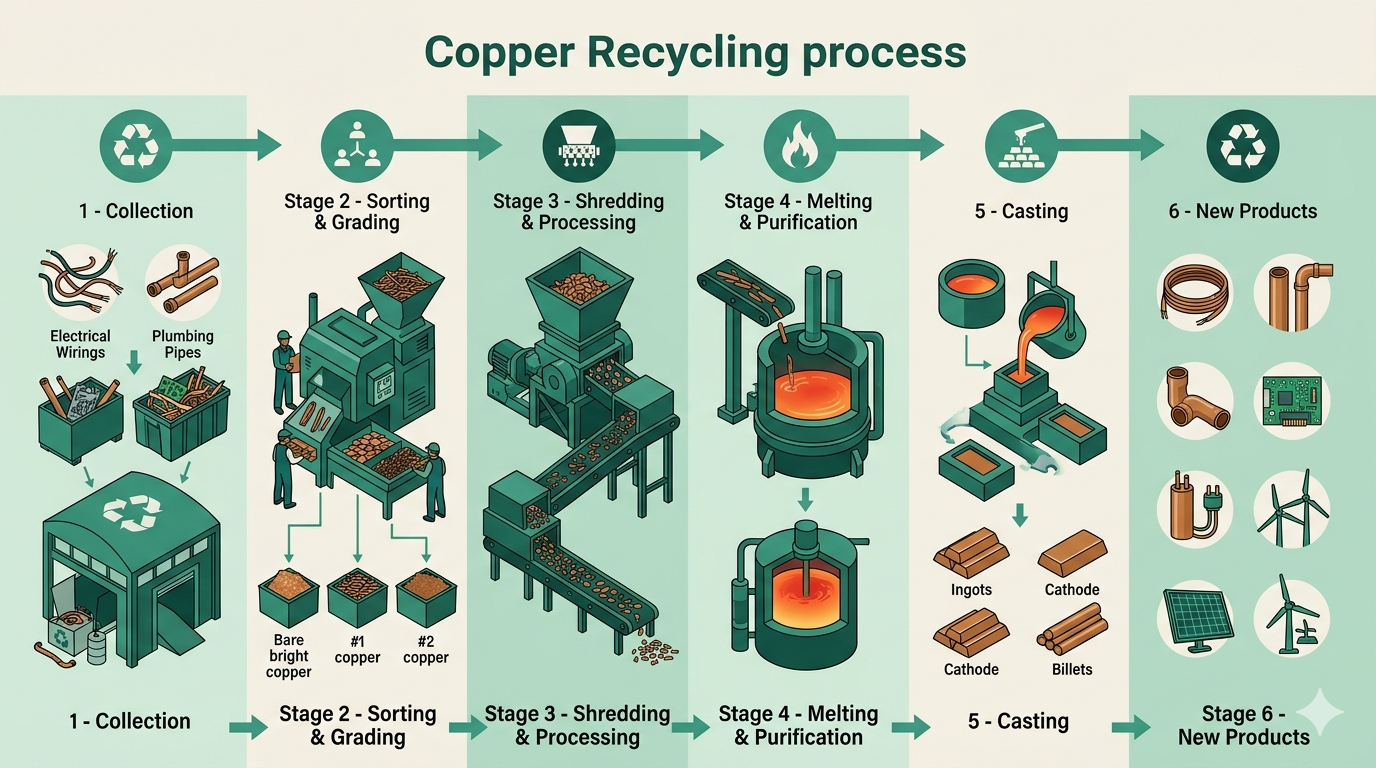
The transformative journey of copper, from discarded scrap material to a valuable new product, is a sophisticated, multi-stage process driven by advanced technology and meticulous engineering.
It typically commences with the crucial phase of collection, where various forms of copper scrap—including insulated and bare wires, pipes, sheets, brass fittings, and components from end-of-life electronics—are systematically gathered from diverse industrial, commercial, and residential sources.
Once collected, the heterogeneous scrap undergoes an initial, critical sorting phase. This involves separating copper from other metals (like aluminum, steel, or brass) and non-metallic materials (such as plastics or insulation).
This often employs a combination of manual inspection, powerful magnetic separation to remove ferrous metals, and advanced eddy current separation for non-ferrous metals. The sorted copper is then subjected to shredding or granulation, where it is broken down into smaller, more uniform pieces.
This step is vital as it increases the material’s surface area, making subsequent processing more efficient, and helps to further remove any remaining impurities, particularly from insulated wires. Following this, the material is melted in a specialized furnace, often alongside a small amount of virgin copper to achieve precise alloy specifications.
During melting, impurities form a slag layer that is carefully removed. The molten copper is then cast into various forms such as ingots, billets, or cathodes, which are high-purity blocks ready to be re-introduced into manufacturing processes for new products.
This highly efficient and infinitely repeatable process ensures that copper can be recycled repeatedly without any significant loss of its inherent quality or properties, firmly establishing it as a truly sustainable and circular material.
Choosing the Right Copper Recycling Partner
Selecting the ideal copper recycling partner requires careful and thorough consideration to ensure both operational efficiency and unwavering environmental responsibility.
To begin, it is paramount to evaluate their certifications and compliance records; actively seek out companies that hold recognized environmental management certifications, such as ISO 14001, which indicates a commitment to environmental management.
Prioritize companies that offer transparent pricing structures and provide detailed reporting on material weights and grades.
Inquire about their advanced recycling technologies to ensure high recovery rates and efficient processing. Consider their operational capacity and logistical support – can they efficiently handle your specific volume of scrap, and do they offer convenient and reliable collection or drop-off services that align with your operational needs?
Transparency in pricing structures and detailed reporting is also absolutely paramount; a reputable company will consistently provide clear, accurate documentation of weights, material grades, and processing fees, ensuring complete accountability.
Finally, seek out companies with a strong, positive reputation for exceptional customer service, reliable communication, and a genuine, demonstrable commitment to sustainable practices. These factors collectively contribute to establishing a reliable, beneficial, and long-term partnership that not only meets your recycling needs but also aligns with your broader sustainability objectives.
Making an informed choice ensures your valuable copper scrap is handled responsibly, efficiently, and ethically, contributing positively to the circular economy.
The Future of Copper Recycling and the Circular Economy
The future of copper recycling is intrinsically and profoundly linked to the broader, evolving vision of a circular economy, a paradigm where resources are kept in use for as long as possible, extracting maximum value from them before regeneration.
As global demand for copper continues its upward trajectory, driven relentlessly by the rapid expansion of electrification, renewable energy technologies (like solar panels and wind turbines), and electric vehicle manufacturing, the strategic importance of recycling will only intensify.
Significant innovations are anticipated and already emerging in areas such as advanced sensor-based sorting technologies, which will possess the capability to identify and separate even minute quantities of copper from increasingly complex and mixed waste streams, particularly from the growing challenge of e-waste.
Research and development efforts are also gaining considerable traction in exploring more energy-efficient and environmentally friendly refining processes, such as bioleaching, which utilizes microorganisms to extract metals.
Furthermore, the pervasive integration of digital technologies, including blockchain for enhanced supply chain transparency and artificial intelligence for real-time process optimization and predictive maintenance, will undoubtedly revolutionize efficiency, traceability, and accountability within the recycling sector.
These collective advancements are poised to enable even higher recovery rates, significantly reduce the environmental impact of copper production, and solidify copper’s indispensable role as a cornerstone material in a truly sustainable, resource-efficient, and circular future economy.

Advanced Recycling Technologies
Top copper recycling companies distinguish themselves through substantial investment in cutting-edge technologies designed to maximize efficiency, purity, and minimize environmental impact.
This technological prowess begins with sophisticated sorting systems, which are critical for separating copper from other metals and non-metallic contaminants.
These often include advanced eddy current separators, optical sorters utilizing spectral analysis, and even robotic systems powered by artificial intelligence that can identify and segregate different grades of copper with remarkable precision.
Following initial sorting, advanced shredding and granulation equipment break down complex scrap, such as insulated wires or electronic components, into smaller, more uniform pieces.
This preparation is essential for subsequent refining processes. For achieving high purity levels, often exceeding 99.9%, companies employ refined hydrometallurgical or pyrometallurgical techniques.
Hydrometallurgy involves chemical leaching to dissolve copper, followed by electrowinning to recover pure metal, while pyrometallurgy uses high-temperature furnaces. These processes are continuously optimized to reduce energy consumption, minimize water usage, and control emissions.
For instance, some facilities utilize inert atmosphere furnaces to prevent oxidation during melting, thereby improving recovery rates and reducing material loss.
The integration of digital technologies and automation further enhances operational safety, precision, and overall resource recovery, ensuring that valuable copper resources are recovered as efficiently and sustainably as possible, thereby contributing significantly to a truly circular economy.
Copper Recycling Challenges
Why is it difficult to recycle copper? Copper recycling is a great way to conserve resources and reduce environmental impact, but it comes with its own set of challenges. Here are some of the key hurdles the industry faces:
Processing Diverse Metal Streams
One of the biggest challenges is dealing with various metal types that often come mixed together. Copper scrap can include everything from aluminum and brass to plastics and other materials. Sorting and separating these different metals efficiently can be quite complex, as each type has its own unique properties.
Scrap Metal Contamination
Another significant issue is contamination. Copper scrap often comes with dirt, oil, paint, and other impurities that can lower the quality of the recycled copper. To ensure that the recovered copper is pure and valuable, recycling facilities need to invest in thorough cleaning and sorting processes, which can be labor-intensive and costly.
Limited Supply of Scrap Copper
As demand for copper continues to rise, the supply of scrap copper can be a limiting factor. Many people and businesses may not realize the importance of recycling their copper-containing products, which means there’s a need for better collection systems and increased awareness about properly disposing of these items.
Keeping Up with Technology
The recycling industry constantly evolves, and keeping up with the latest technologies can be challenging. While new methods can improve efficiency and reduce costs, they often require significant upfront investment. Finding the right balance between adopting new technologies and managing expenses is crucial for many recycling operations.
Environmental Considerations
While recycling copper is generally more environmentally friendly than producing new copper from raw materials, there’s still room for improvement. The industry needs to optimize processes to minimize its environmental footprint further. This includes exploring greener extraction methods and using renewable energy sources in recycling facilities.
Market Volatility
Finally, the copper market can be quite volatile, fluctuating prices based on global demand and supply. This unpredictability can impact copper recycling prices and the profitability of its operations. To navigate this challenge, many businesses are diversifying their services, processing a wider range of materials, and seeking new markets for recycled copper products.
While copper recycling plays a vital role in sustainability, it faces several challenges that require innovative solutions and a collaborative effort across the industry.

Copper Recycling Methods
Copper recycling employs several different ways to recover and repurpose this valuable metal. Here are the top methods used in the industry:
1. Collection and Sorting
Recycling begins with collecting scrap copper from various sources, such as construction sites, electrical devices, and plumbing systems. Once collected, the copper is sorted into different grades based on its purity and type.
This is important for determining its value and the appropriate recycling method. Here are the different kinds of sorting technologies used:
Manual Sorting: Workers physically inspect and separate copper from other materials based on visual cues and experience. This method is labor-intensive and less efficient.
Magnetic Sorting: This technique uses magnets to separate ferrous metals from non-ferrous metals like copper, ensuring that unwanted iron and steel components are removed.
X-Ray Sorting: X-ray sorting systems utilize X-ray transmission and fluorescence technologies to analyze the density and elemental composition of materials.
This allows for precise separation of copper from other metals, even in heavily contaminated conditions. Systems like the STEINERT XSS T EVO 5.0 can differentiate between various materials based on their characteristics, enhancing recovery rates and purity levels.
AI Technology: Artificial Intelligence enhances sorting efficiency by analyzing data to identify and categorize copper materials. AI algorithms can optimize sorting processes by predicting material compositions and improving logistics, leading to better resource recovery and reduced waste.
Optical Sorting: This method employs high-resolution cameras and sensors to detect and sort materials based on color and shape. It is effective for separating clean copper from mixed materials but may struggle with heavily contaminated scraps.
2. Mechanical Processing
After sorting, the copper is mechanically processed using various techniques:
Shredding and Granulating: Copper is shredded into smaller pieces to facilitate easier handling and processing. Granulators further reduce the size of the copper, separating it from insulation and other materials.
Magnetic Separation: This method removes ferrous metals from copper scrap. Since copper is non-ferrous, magnets effectively separate unwanted iron and steel components.
Gravity Separation: This technique utilizes differences in density to separate copper from lighter materials, ensuring a higher purity of the final product.
3. Induction Smelting
Once the copper is sufficiently processed and cleaned, it is melted down in induction furnaces. This method is efficient and environmentally friendly, requiring less energy than traditional smelting methods.
The molten copper can then be cast into various forms, such as ingots or rods, ready for manufacturing new products.
4. Electrolytic Refining
In some cases, particularly for high-purity copper, electrolytic refining is used. This involves dissolving the impure copper in an electrolyte solution and then using electrolysis to deposit pure copper onto cathodes.
This method yields very high-purity copper, which is suitable for electrical applications.
5. Recycling of Electronic Waste
A significant portion of copper comes from electronic waste (e-waste) containing various metals. Advanced recycling techniques are employed to recover copper and other valuable metals like gold and silver.
This process often involves shredding the e-waste, followed by various separation techniques to isolate copper from other materials.

As you can see, copper recycling is a complex, multi-step process that not only conserves resources but also reduces energy consumption and greenhouse gas emissions.
In Summary
Copper recycling is a vital element of a sustainable future, and we have highlighted just a few of the companies leading the way in innovative recovery techniques essential to global environmental responsibility and a more sustainable economy.
As the demand for copper continues to grow, the recycling efforts of these companies will only become more critical.
By supporting their work and promoting the importance of copper recycling, we can ensure that this versatile and valuable metal remains a key player in the circular economy for generations to come.
Frequently Asked Questions
How does recycling copper benefit the environment?
Recycling copper significantly reduces energy consumption and CO2 emissions compared to mining new copper. It requires only about 10 GJ/tonne of energy for recycling, compared to 100 GJ/tonne for extraction from ore.
What are the main uses of copper in industries?
Copper is widely used in electrical applications (44%), construction (20%), transportation (12%), and consumer goods like cookware and jewelry (10%). Its excellent conductivity makes it essential for power generation and transmission
Is recycled copper financially viable?
Yes, recycled copper is economically beneficial, often valued at up to 90% of the cost of newly mined copper. Continuous recycling helps maintain a stable supply and lower costs for copper products.
What types of copper can be recycled?
Almost all types of copper can be efficiently recycled, demonstrating its remarkable versatility and infinite recyclability. This includes a wide array of forms such as bare bright wire, insulated copper wire (which requires additional processing to remove insulation), copper tubing and pipes commonly found in plumbing, copper sheets, brass (an alloy of copper and zinc), bronze (an alloy of copper, typically with tin), and various other copper alloys present in electronics, industrial machinery, and consumer goods scrap. The specific purity and physical form of the copper scrap will influence its market value and the particular processing method required for its reclamation.
How much energy is saved by recycling copper compared to new production?
Recycling copper offers truly substantial energy savings when compared to the energy-intensive process of producing new copper from virgin ore. Typically, recycling copper saves an impressive 85% to 90% of the energy that would otherwise be consumed in mining, smelting, and refining raw copper. This dramatic reduction in energy consumption is not only economically beneficial but also translates directly into significantly lower greenhouse gas emissions, thereby contributing substantially to climate change mitigation efforts and reducing the overall carbon footprint of the copper supply chain.
Is recycled copper of the same quality as newly mined copper?
Absolutely, yes. Recycled copper retains all the inherent physical and chemical properties of virgin copper. It can be melted down, refined, and reformed into new products repeatedly without any degradation in its quality, strength, conductivity, or other essential characteristics. This makes copper a truly sustainable and infinitely recyclable material, capable of being used in a continuous loop for various applications, from electrical wiring to plumbing and construction, without compromising performance.
How can I find a reputable copper recycling company for my business or personal needs?
To find a reputable copper recycling company, begin by looking for firms with strong environmental certifications, such as ISO 14001, which indicates a commitment to environmental management. Prioritize companies that offer transparent pricing structures and provide detailed reporting on material weights and grades. Inquire about their advanced recycling technologies to ensure high recovery rates and efficient processing. Consider their operational capacity and logistical support, including convenient collection or drop-off services. Finally, seek out companies with a solid reputation for excellent customer service, clear communication, and a demonstrable commitment to sustainable and ethical business practices. Online reviews, industry associations, and local business directories can also be valuable resources.
References
VisualCapitalist: The State Of Copper Recycling In The US
United Nations Institute For Training & Research: Global e-Waste Monitor 2024
Smithers: The Future of Industrial Mineral and Metal Recycling to 2024
Statista: Global Copper Usage 2010-2022