


The world generates over 60 million metric tonnes of e-waste annually—and that figure climbs every year. From smartphones with planned obsolescence to data centers retiring servers by the thousand, electronic waste has become one of the fastest-growing environmental challenges of our time.
But where there’s waste, there’s opportunity. A new wave of waste management startups are transforming the e-waste problem into a circular economy, recovering precious metals, extending device lifespans, and keeping toxic materials out of landfills.
Understanding E-Waste and the Need for Responsible Recycling
E-waste is now the world’s fastest-growing waste stream—and one of its most paradoxical. Discarded electronics contain hazardous materials like lead, mercury, and cadmium that can leach into soil and groundwater. Yet they also hold valuable resources: gold, silver, copper, and rare earth elements that are energy-intensive and environmentally costly to mine.
This makes recycling more than an environmental safeguard—it’s an economic imperative. Recovering materials from old devices reduces demand for virgin extraction, cuts carbon emissions, and keeps toxic components out of landfills. The best e-waste recycling companies understand this dual mandate: protect ecosystems while capturing value that would otherwise be buried or burned.
What is E-Waste?
Before getting straight to the best e-waste companies and startups out there right now, let’s first understand what e-waste is.
Electronic waste, commonly known as e-waste, encompasses discarded electronic devices like computers, smartphones, tablets, and televisions. Proper disposal is important because these devices may contain harmful materials, such as lead, mercury, and cadmium, that can be hazardous to the environment and human health.
E-waste is a growing concern globally as technology advances and more devices are discarded.
The market for electronics is experiencing a substantial surge owing to the rapid development of technology and the rise in the use of electronic devices.
However, this growth has also led to a surge in e-waste pollution, posing environmental and health risks.
Watch this video by DW Documentary to learn more:
According to Statista, the e-waste management market across the world had a valuation of USD 58.86 billion in 2023. It is projected to reach a valuation of USD 137 billion by 2029.
This growth is driven by increasing electronic waste generation, stringent regulations regarding e-waste disposal, and the growing awareness of the environmental impact of improper e-waste management.
Despite the potential of the e-waste market, the improper disposal of e-waste remains a significant challenge.
Many countries lack proper e-waste recycling facilities, leading to e-waste being dumped in landfills or processed in informal recycling facilities, posing health and environmental risks.
Common Types of E-Waste Accepted for Recycling
The spectrum of electronic devices that qualify as e-waste is vast, encompassing nearly anything with a plug or a battery. Understanding what can be recycled is the first step toward responsible disposal. The best e waste recycling facilities are equipped to handle a wide array of items, ensuring that valuable components are recovered and hazardous materials are managed safely. Here are some common categories:
Consumer Electronics: This includes personal computers (desktops, laptops, tablets), mobile phones, televisions (CRT, LCD, LED), printers, scanners, cameras, and audio equipment.
Large Household Appliances: Items like refrigerators, washing machines, dryers, dishwashers, and microwaves often contain significant amounts of metal and other recyclable materials, but also refrigerants and other hazardous substances that require specialized handling.
Small Household Appliances: Toasters, blenders, vacuum cleaners, and electric kettles, while seemingly minor, contribute to the e-waste stream and should be recycled.
IT and Telecommunications Equipment: Servers, networking equipment, office phones, and other business-grade electronics are frequently upgraded and require secure, compliant recycling.
Batteries: All types of batteries, from AA to lithium-ion packs, contain chemicals that are harmful if landfilled and valuable materials if recycled. Many e-waste recyclers offer dedicated battery collection.
It’s always advisable to check with your chosen recycling provider for a comprehensive list of accepted items, as capabilities can vary.
What Makes an E-Waste Recycler the Best?
When seeking the best e waste recycling services, it’s crucial to look beyond simple disposal. A truly superior recycler adheres to stringent standards that ensure environmental protection, data security, and ethical practices. Here are the key criteria to consider:
Certifications and Compliance: The gold standard for e-waste recyclers includes certifications like R2 (Responsible Recycling) and e-Stewards. These certifications ensure that companies follow strict guidelines for data destruction, environmental health and safety, and responsible management of toxic materials. They also prohibit the export of hazardous e-waste to developing countries, a common unethical practice.
Data Security: For businesses and individuals, the secure destruction of data on hard drives and other storage devices is paramount. The best recyclers offer certified data destruction services, including physical shredding and software-based wiping, providing certificates of destruction for peace of mind.
Transparency and Traceability: A reputable recycler will be transparent about their processes, allowing you to understand where your e-waste goes and how it’s handled. They should provide clear documentation and be able to trace the downstream flow of materials.
Environmental Responsibility: This includes minimizing landfill use, maximizing material recovery, and employing environmentally sound processing techniques. They should have robust environmental management systems in place to prevent pollution.
Accessibility and Convenience: While not directly tied to ‘best practices,’ a convenient drop-off or pick-up service can significantly impact participation rates, making it easier for more people and businesses to recycle responsibly.
A Comparison Table of Key e-Waste Recycler Certifications
| Certification | Governing Body | What It Guarantees | Key Requirements |
|---|---|---|---|
| 🏆 Primary E-Waste Recycling Standards (EPA-Recognised) | |||
| R2 (Responsible Recycling) Current version: R2v3 |
SERI (Sustainable Electronics Recycling International) ANSI-accredited standard |
|
|
| e-Stewards Current version: 4.1 |
Basel Action Network (BAN) Non-profit watchdog organisation |
|
|
| 🔒 Data Security Certifications | |||
| NAID AAA National Association for Information Destruction |
i-SIGMA (International Secure Information Governance & Management Association) |
|
|
| 🌍 Environmental & Quality Management Systems | |||
| ISO 14001 Environmental Management System |
International Organization for Standardization (ISO) |
|
|
| RIOS Recycling Industry Operating Standard |
ISRI (Institute of Scrap Recycling Industries) |
|
|
| ISO 45001 Occupational Health & Safety |
International Organization for Standardization (ISO) |
|
|
| ISO 9001 Quality Management System |
International Organization for Standardization (ISO) |
|
|
| ⚖️ R2 vs e-Stewards: Key Differences at a Glance | |||
| Aspect | R2 | e-Stewards | |
| Data Security | Required but NAID AAA optional | Mandatory NAID AAA certification | |
| Export Policy | Allows export to developed countries under controlled conditions | Strict ban on hazardous exports to developing nations; Basel Convention compliance required | |
| Facility Coverage | Individual facility certification | All corporate facilities must be certified | |
| Landfill/Incineration | Permitted for non-toxic materials if no viable alternatives | Prohibited for toxic materials under all circumstances | |
| Prison Labour | Not specifically addressed | Explicitly prohibited | |
| Cost & Flexibility | More predictable pricing; allows custom standards within core requirements | Higher costs; stricter, more uniform requirements across all vendors | |
| Best For | Businesses needing flexibility with cross-border operations | Organisations prioritising strictest environmental and social justice standards | |
Note: Both R2 and e-Stewards are recognised by the U.S. Environmental Protection Agency (EPA) as accredited certification standards for electronics recyclers. Many leading recyclers hold both certifications to demonstrate maximum commitment to responsible e-waste management.
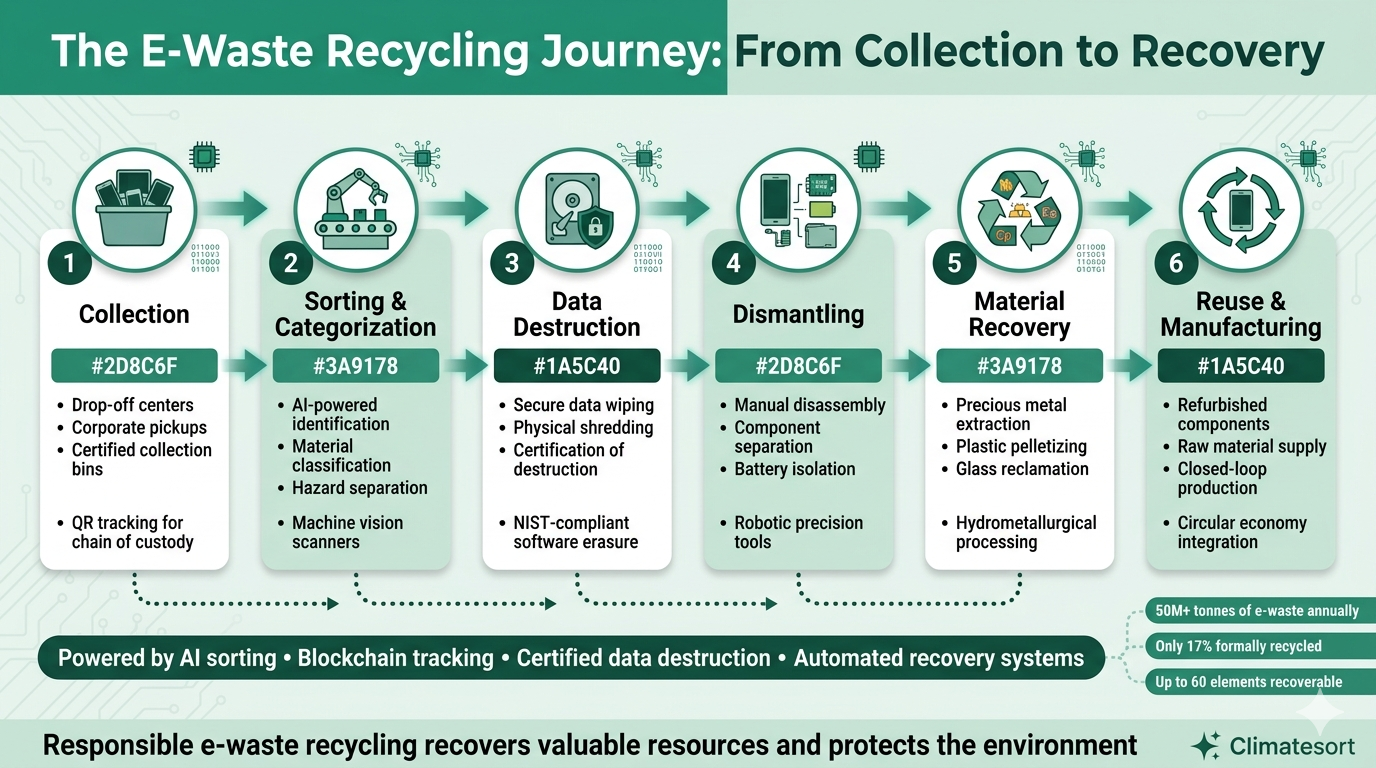
The E-Waste Recycling Process: From Collection to Recovery
The journey of e-waste from a discarded item to reusable raw materials is a complex, multi-stage process designed to maximize recovery and minimize environmental impact. Understanding this process helps in appreciating why choosing the best e waste recycling service is so important. Here’s a general overview:
1. Collection: E-waste is collected from various sources, including drop-off centers, corporate pickups, and municipal events.
2. Sorting: Upon arrival at a facility, items are initially sorted by type and condition. Functional items might be refurbished for reuse, while others are designated for material recovery.
3. Data Destruction: For devices containing sensitive information, certified data destruction is performed. This can involve software wiping for reusable devices or physical shredding for those destined for material recovery, ensuring no personal or proprietary data remains.
4. Dismantling and Segregation: Skilled technicians manually dismantle larger items, separating components like circuit boards, plastics, metals, and batteries. This step is crucial for isolating hazardous materials and preparing different streams for specialized processing.
5. Material Processing: Each segregated material stream undergoes further processing. Metals are often shredded and melted down, plastics are granulated and sorted by type, and glass is cleaned and crushed. Specialized processes are used for circuit boards to recover precious metals like gold, silver, and palladium.
6. Refining and Reuse: The recovered raw materials are then sent to manufacturers to be incorporated into new products, completing the circular economy loop. This reduces the need for virgin resources and significantly lowers the environmental footprint of new electronics.
The Environmental and Economic Benefits of E-Waste Recycling
Engaging in responsible e-waste recycling offers many benefits that extend far beyond simply clearing out old gadgets. By choosing the best e waste recycling practices, we contribute significantly to environmental health, resource conservation, and economic growth. These advantages underscore the critical role that proper disposal plays in building a sustainable future:
Mitigation of Hazardous Waste: E-waste contains toxic substances such as lead, mercury, cadmium, and brominated flame retardants. Recycling prevents these harmful chemicals from contaminating soil and groundwater, protecting ecosystems and human health.
Conservation of Natural Resources: Many electronic devices contain valuable metals like gold, silver, copper, and palladium, as well as plastics and glass. Recycling these materials reduces the need for mining and extracting new raw materials, which are often energy-intensive and environmentally destructive processes.
Reduction of Greenhouse Gas Emissions: Manufacturing new products from recycled materials typically requires less energy than producing them from virgin resources. This reduction in energy consumption directly translates to lower greenhouse gas emissions, helping combat climate change.
Creation of Green Jobs: The e-waste recycling industry supports a growing number of jobs in collection, sorting, dismantling, and material processing. This contributes to local economies and fosters a workforce dedicated to sustainability.
Support for a Circular Economy: By keeping materials in use for as long as possible and recovering them at the end of their life, e-waste recycling is a cornerstone of the circular economy. This model minimizes waste and maximizes resource efficiency, moving away from a linear ‘take-make-dispose’ approach.
Environmental and Economic Implications
The improper disposal of e-waste poses serious health, environmental, and climate risks. In 2022 alone, $62 billion worth of recoverable natural resources were left unaccounted for due to inadequate e-waste management.
On a positive note, recycling metals from e-waste instead of extracting new raw materials avoided approximately 52 million metric tons of planet-warming emissions in the same year.
Navigating the Regulatory Landscape: Compliance for E-Waste Recycling
The global e-waste crisis has prompted governments worldwide to implement stringent regulations governing the disposal and recycling of electronic devices. For businesses and consumers alike, understanding this regulatory landscape is crucial to ensure responsible e-waste management and avoid legal repercussions.
Key international agreements, such as the Basel Convention, aim to control the transboundary movements of hazardous wastes, including e-waste, preventing its dumping in developing countries.
Domestically, regions like Europe have the Waste Electrical and Electronic Equipment (WEEE) Directive, which mandates producers to take responsibility for their products’ end-of-life.
In the United States, various state-specific laws dictate collection, recycling targets, and producer responsibility. E-waste recycling startups play a vital role in helping organizations navigate these complex requirements.
Many are certified under standards like R2 (Responsible Recycling) or e-Stewards, which ensure environmentally sound practices, data security, and worker health and safety.
Partnering with a certified e-waste recycling startup provides assurance that your electronic waste is handled in full compliance with all applicable laws and ethical standards, protecting your brand and contributing to a cleaner planet.
Technological Advancements in E-Waste Management
The e-waste management industry is witnessing significant technological advancements:
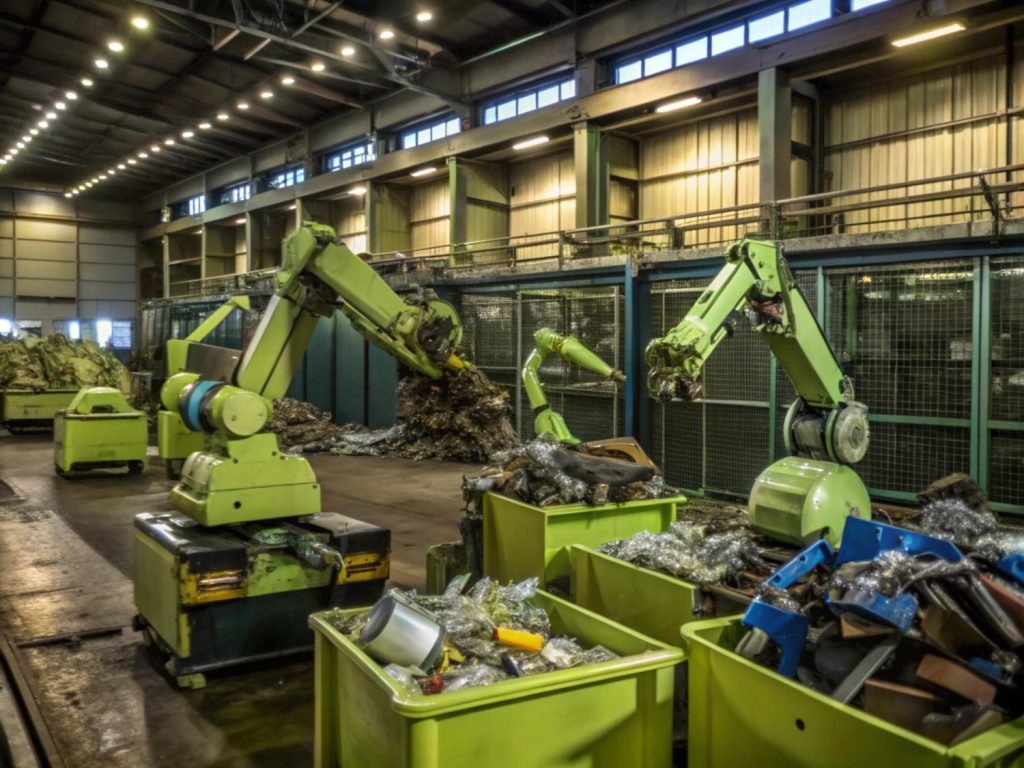
- AI and robotics are being developed for various applications, including identifying and removing batteries, and determining less labor-intensive processing methods.
- Advanced recycling technologies and eco-design are emerging as major trends.
- Digital solutions are being integrated into e-waste management processes, enhancing efficiency and traceability.
Innovation and Funding Driving E-Waste Recycling Startups
The ‘startup’ designation in e-waste recycling signifies a dynamic sector fueled by groundbreaking innovation and significant investment.
Unlike traditional waste management companies, e-waste recycling startups often emerge with novel technologies and business models designed to tackle specific challenges in the e-waste stream. They are agile, customer-centric, and typically driven by a dual mission of environmental impact and economic viability.
These startups are leveraging cutting-edge advancements, from AI-powered sorting robots that can identify and separate materials with unprecedented accuracy to chemical recycling processes that recover high-purity raw materials from complex electronic components.
Their innovative spirit attracts substantial venture capital and angel investment, as investors recognize the immense market potential and the urgent need for sustainable solutions.
This influx of funding allows e-waste recycling startups to scale their operations, refine their technologies, and expand their reach, rapidly transforming the landscape of electronic waste management.
Their focus on R&D and disruptive approaches positions them as key players in achieving a truly circular economy for electronics.
Market Growth and Regional Insights
The global e-waste management market is experiencing significant growth. In 2024, the market was valued at approximately $70 billion and is projected to reach $81.27 billion in 2026, reflecting a compound annual growth rate (CAGR) of 16.1%.
By 2028, the market is expected to reach $118.32 billion, growing at a CAGR of 14.0%.
Regionally, Europe leads in e-waste recycling efficiency, with a recycling rate of 42.8%. However, the Asia Pacific region dominated the market in 2024, holding 47.5% of the share and showing significant potential for further growth.
Challenges and Innovative Solutions
The widening gap between e-waste generation and recycling capacity continues to pose a major challenge. To address this issue, companies and governments are implementing improved collection systems, such as setting up collection points at shopping malls, to boost recycling rates.
Furthermore, organizations are rolling out Extended Producer Responsibility (EPR) programs and launching public awareness campaigns to combat the e-waste crisis.
These initiatives aim to educate consumers, increase participation in recycling efforts, and hold manufacturers accountable for the entire lifecycle of their products. By combining these strategies, stakeholders hope to bridge the gap between e-waste production and proper recycling, ultimately reducing the environmental impact of discarded electronic devices.
IT Asset Disposition (ITAD) and Secure Data Destruction
For businesses, the responsible disposal of electronic assets goes beyond mere recycling; it involves IT Asset Disposition (ITAD). This comprehensive process ensures that end-of-life IT equipment, such as computers, servers, and data storage devices, is managed securely and compliantly.
E-waste recycling startups often specialize in ITAD, offering services that protect sensitive corporate data and mitigate environmental impact.
One of the most critical aspects of ITAD is secure data destruction. Simply deleting files isn’t enough; data can often be recovered from discarded devices.
Reputable e-waste recycling startups employ certified methods like physical destruction (shredding, crushing), degaussing (demagnetizing storage media), or secure data wiping to ensure that no proprietary or confidential information can be retrieved.
This is vital for maintaining data privacy, preventing breaches, and adhering to strict regulatory requirements like GDPR, HIPAA, and various state-specific data protection laws.
By partnering with an e-waste recycling startup that prioritizes secure data destruction, your organization can safeguard its reputation and avoid costly legal penalties.
Let let’s look at at 10 e-waste companies making a difference in 2026.
e-Waste Companies Making a Difference


E-Waste Recycling Companies Comparison Table
| Company | Focus Area | Key Features | Unique Selling Proposition |
|---|---|---|---|
| 🔥 Plasma & Advanced Processing Technology | |||
| Tetronics Swindon, UK · 1964 |
Plasma Arc E-Waste Processing |
|
60+ years pioneering plasma technology that eliminates hazardous materials while recovering precious metals from e-waste at industrial scale |
| 🏭 Large-Scale E-Waste Recycling & ITAD | |||
| ERI Fresno, CA, USA · 2002 |
Full-Service E-Waste & ITAD |
|
World’s first dual NAID/e-Stewards certified recycler; most advanced e-waste shredding system globally with international coverage in 46 countries |
| Sims Lifecycle Services Mascot, Australia · 2002 |
Global ITAD & Data Center Services |
|
Publicly traded (Sims Limited) global ITAD leader with Circular Centers for data center hardware reuse and spare parts recovery |
| Stena Metall Group Gothenburg, Sweden · 1939 |
Nordic Electronics & Battery Recycling |
|
Europe’s leading Nordic recycler processing 6 million tonnes annually with Stena Nordic Recycling Center for circular electronics and hazardous waste |
| REMONDIS Sverige Sweden · 1934 |
Full-Service Waste & E-Waste Management |
|
World’s third-largest recycling company with 1,500+ locations in 30+ countries; integrated e-waste-to-energy and circular material flows |
| Cohen Recycling Middletown, OH, USA · 1924 |
Regional Scrap Metal & Electronics |
|
Century-old family business (4 generations) pioneering accessible public drive-thru recycling with auto shredding and electronics recovery |
| 🤖 AI & Robotics-Powered Recycling | |||
| AMP Robotics Broomfield, CO, USA · 2015 |
AI-Powered Waste Sorting |
|
Industry-leading AI neural network trained on 200 billion+ data points; robots sort 2x faster than humans with modular retrofit capability |
| ⚗️ Precious Metals Refining & Smelting | |||
| Umicore Brussels, Belgium · 1805 |
Precious Metals & Battery Recycling |
|
220+ years of materials expertise; world’s most advanced closed-loop battery-to-battery recycling returning battery-grade metals to cathode production |
| Boliden Stockholm, Sweden · 1924 |
Industrial E-Scrap Smelting |
|
World’s largest e-scrap smelter turning circuit boards into copper, gold, and zinc with industry-leading environmental controls |
| 🔋 Battery Recycling & Circular Supply Chain | |||
| Redwood Materials Carson City, NV, USA · 2017 |
EV Battery Circular Supply Chain |
|
Founded by ex-Tesla CTO; North America’s largest Li-ion recycler creating first fully domestic closed-loop battery supply chain |
| Aqua Metals Reno, NV, USA · 2013 |
Clean Battery Recycling Technology |
|
Only commercially proven electro-hydrometallurgical battery recycler; eliminates smelting emissions while producing ultra-pure battery-grade metals |
| 🧲 Rare Earth & Specialty Materials Recovery | |||
| Noveon Magnetics San Marcos, TX, USA · 2014 |
Rare Earth Magnet Recycling |
|
Only technology producing recycled rare earth magnets stronger than originals; reshoring critical magnet supply chain with closed-loop manufacturing |
| 🏠 Consumer Services & Social Impact | |||
| Ridwell Seattle, WA, USA · 2019 |
Consumer Hard-to-Recycle Pickup |
|
Consumer subscription service filling curbside recycling gaps; 15+ million pounds diverted from landfill with full supply chain transparency |
| Reconome London, UK · 2018 |
Circular IT & Digital Inclusion |
|
Exclusive technology partner for UK National Device Bank; turning corporate e-waste into digital inclusion while bridging the 1-in-6 digital divide |
What Services Do E-Waste Recycling Startups Provide?
E-waste recycling startups are at the forefront of developing innovative solutions for electronic waste. Their service offerings are diverse, catering to both individual consumers and large enterprises. Understanding these services can help you choose the right partner for your e-waste management needs. Here are some key services you can expect:
Collection and Logistics: Many startups offer convenient pickup services for bulk e-waste, often including secure transportation to their processing facilities. This can range from scheduled corporate collections to community drop-off events.
Sorting and Dismantling: Advanced sorting technologies, often incorporating AI and robotics, allow for efficient separation of materials. Devices are carefully dismantled to recover valuable components and separate hazardous materials.
Data Destruction: As discussed, secure data destruction is paramount. Startups provide certified methods to ensure all data on storage devices is irretrievably erased or physically destroyed.
Refurbishment and Resale: Functional or repairable devices are often refurbished and remarketed, extending their lifespan and reducing the need for new manufacturing. This contributes significantly to the circular economy.
Material Recovery: Non-reusable components are processed to extract raw materials like precious metals (gold, silver, copper), plastics, and glass, which are then reintroduced into manufacturing supply chains.
Compliance Reporting: For businesses, startups often provide detailed reports and certificates of destruction or recycling, ensuring adherence to environmental regulations and corporate sustainability goals.
Choosing Your Best E-Waste Recycling Partner
Selecting the best e waste recycling partner is a decision that impacts not only your immediate needs but also the broader environmental landscape. Whether you are an individual looking to dispose of an old smartphone or a corporation managing a large inventory of IT assets, the principles remain the same: prioritize certified, transparent, and environmentally responsible services. Look for companies that offer clear data destruction policies, adhere to international standards like R2 or e-Stewards, and demonstrate a commitment to maximizing material recovery.
By making informed choices, we collectively contribute to a more sustainable future. Proper e-waste management helps conserve precious resources, reduces pollution, and supports a circular economy where waste is minimized, and materials are continuously reused.
Take the initiative today to research and partner with a recycler that aligns with your values and meets the highest industry standards. Your efforts in responsible e-waste disposal are a crucial step towards protecting our planet for generations to come.
In Summary
The e-waste challenge demands bold and innovative solutions, and these e-waste companies and startups are rising to the occasion. With their cutting-edge recycling processes, commitment to the environment, and vision for a circular economy, they are redefining e-waste management. As we look towards 2026 and beyond, these industry leaders will play a pivotal role in shaping a more sustainable future, where valuable resources are recovered and reused, minimizing the environmental impact of our digital age.
Frequently Asked Questions
What is e-waste?
E-waste, or electronic waste, refers to discarded electronic devices and components, such as computers, smartphones, TVs, and other consumer electronics, that are no longer in use.
Why is e-waste management important?
Proper e-waste management is crucial for reducing environmental pollution, recovering valuable materials, preventing toxic substances from entering the ecosystem, and promoting sustainable resource use.
What services do e-waste companies provide?
E-waste companies offer services such as collection, recycling, refurbishment, data destruction, and safe disposal of electronic devices and components.
How do these e-waste companies contribute to sustainability?
These companies contribute to sustainability by ensuring that electronic waste is properly processed, valuable materials are recovered and reused, and harmful substances are safely managed, reducing the overall environmental impact.
What innovations are these e-waste companies implementing?
Innovations include advanced recycling technologies, automated sorting systems, environmentally friendly extraction processes, and circular economy models that extend the lifecycle of electronic products.
References
Statista: Global Electronic Waste Management Market Value from 2022 to 2029
The World Counts: Tons of Waste Dumped Yearly Facts
Globe News Wire: Emission Control Catalysts Global Market Report 2024
Grand View Research: Magnetic Materials Market Analysis and Forecast 2022 – 2030